ここから本文です
TWO:

Hydrocyclone (liquid cyclone)01

Hydrocyclone (liquid cyclone)02

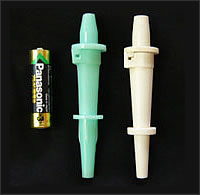
A hydrocyclone (liquid cyclone) injects treatment solution into stationary equipment to perform separation, classification, and concentration, and is an innovative separator with a very simple structure and no drive unit.

Structure of a hydrocyclone (liquid cyclone)

A suspension containing fine particles of several micrometers or more is supplied to a cylindrical container circumferentially at high speed. And as a result it starts to rotate and a centrifugal force is generated. At this time a gravitational acceleration of several tens of thousands of G is generated in the circumferential direction, and thus leading to fast sedimentation and concentration of the fine particles. The separated concentration can be freely selected by changing the supply rate (supply pressure and flow rate) and the flow ratio of the outlet. Our hydrocyclone (liquid cyclone) was designed and manufactured to classify and concentrate fine particles, and so has a small element.

THREE:And, for some time, events seemed to justify these apprehensions by the old governing class. Not a plan of Pitt's but failed. His first enterprise was one of that species that has almost universally faileda descent on the coast of France. Early in September a fleet of sixteen ships of the line, attended by transports and frigates, was despatched to Rochefort, carrying ten regiments of foot, under the command of Sir John Mordaunt. Sir Edward Hawke commanded the fleet, and the troops were landed[127] on a small fortified island named Aix, at the mouth of the Charente. There, in spite of strict orders, the English soldiers and sailors became awfully drunk, and committed shocking excesses and cruelties on the inhabitants. The rumour of this made the forces in Rochefort furious for vengeance; and when the army was to be landed within a few miles of the place in order to its attack, as usual in such cases, the admiral and general came to an open quarrel. Mordaunt betrayed great timidity, and demanded of Hawke how the troops, in case of failure, were to be brought off again. Hawke replied, that must depend on wind and tidean answer which by no means reassured Mordaunt. General Conway, next in command to Mordaunt, was eager for advancing to the attack; and Colonel Wolfeafterwards the conqueror of Quebecoffered to make himself master of Rochefort with three ships of war and five hundred men at his disposal. The brave offer was rejected, but the report of it at once pointed out Wolfe to Pitt as one of the men whom he was on the look-out to work with. Howe, the next in command to Hawke, proposed to batter down the fort of Fouras before advancing on Rochefort; but Mordaunt adopted the resort of all timid commandersa council of warwhich wasted the time in which the assault should have been made, and then it was declared useless to attempt it; the fortifications of Aix were destroyed, and the fleet put back. Mordaunt, like Byng, was brought before a court-martial, but with very different results. He was honourably acquittedperhaps, under the atrocious 12th Article of War, the Court feared even to censure; and it was said by the people that Byng was shot for not doing enough, and Mordaunt acquitted for doing nothing at all.
  • Equipment costs can be reduced.
  • Operating costs can be reduced.
  • Maintenance costs can be reduced.
  • Any change in raw material and product can be easily addressed.
  • Large amounts can be treated in a small area.
  • Separation and cleaning are easy because of the simple structure.
  • Simplified control
  • This equipment can be operated in synchronization with external devices.
  • Alarm and interlock mechanism.
THREE:Britain had seen her Continental Allies fall away one by one. The time was now approaching when some good allies might have been very useful to herself, if such people were ever to be found. We have seen that, during the American Revolution, the rebellious colonists found admirable allies in the Irish. They had no difficulty in exciting disturbances amongst that ardent Celtic race, and thus greatly to augment our difficulties. No sooner did the French commence the work of revolution than the Irish became transported with admiration of their doings. Not all the bloodshed and horrors of that wild drama could abate their delight in them, and their desire to invite them over to liberate Ireland, as they had liberated Belgium. These views found expression in the north of Ireland, especially in Belfast and other places, where the population was Presbyterian and to a certain extent Republican. The Roman Catholics were inert, and disposed to wait patiently. Ever since the American revolt the necessity of conciliating the Irish had been impressed on the British Government, and many important concessions had been granted them. They had not yet obtained Catholic emancipation, but the public mind was ripening for it, and the chief difficulty was the opposition of the extreme Protestant party in the Irish Parliament. Whatever were the evils which England had inflicted on Ireland, they were nothing compared with those which French fraternity would have perpetrated. But the United Irishmen, as the revolutionaries called themselves, could see nothing of this, not even after all the world had witnessed the French mode of liberating Belgium, and French waggons, guarded by soldiers, were day after day, and month after month, bearing over the Alps the priceless chefs-d'?uvre of the arts from ravaged Italy. In the spring of 1798 the preparations of the French Directory for the invasion of Ireland were too open and notorious to be overlooked by anybody."NAPOLEON."
  • Classification and concentration for the manufacture of inorganic powder materials
  • Classification of ceramic materials
  • Removal of fine particles, including iron powder
  • Removal of fine particles from pigments
  • Removal of fine organic particles from solvents
  • Separation of starch and yeast
  • Removal of fine particles from high-temperature strong acid solutions
  • Removal of fine particles from low-temperature solutions